forest
The chir pine and the deodar — two great trees of the Garhwal forest
Most of the forest above Chaptari is one of two trees — chir pine below 2,200 m and deodar above. They look similar, they are not. What each does and what they tell you about a slope.
· Sameer Jain · 5 min read
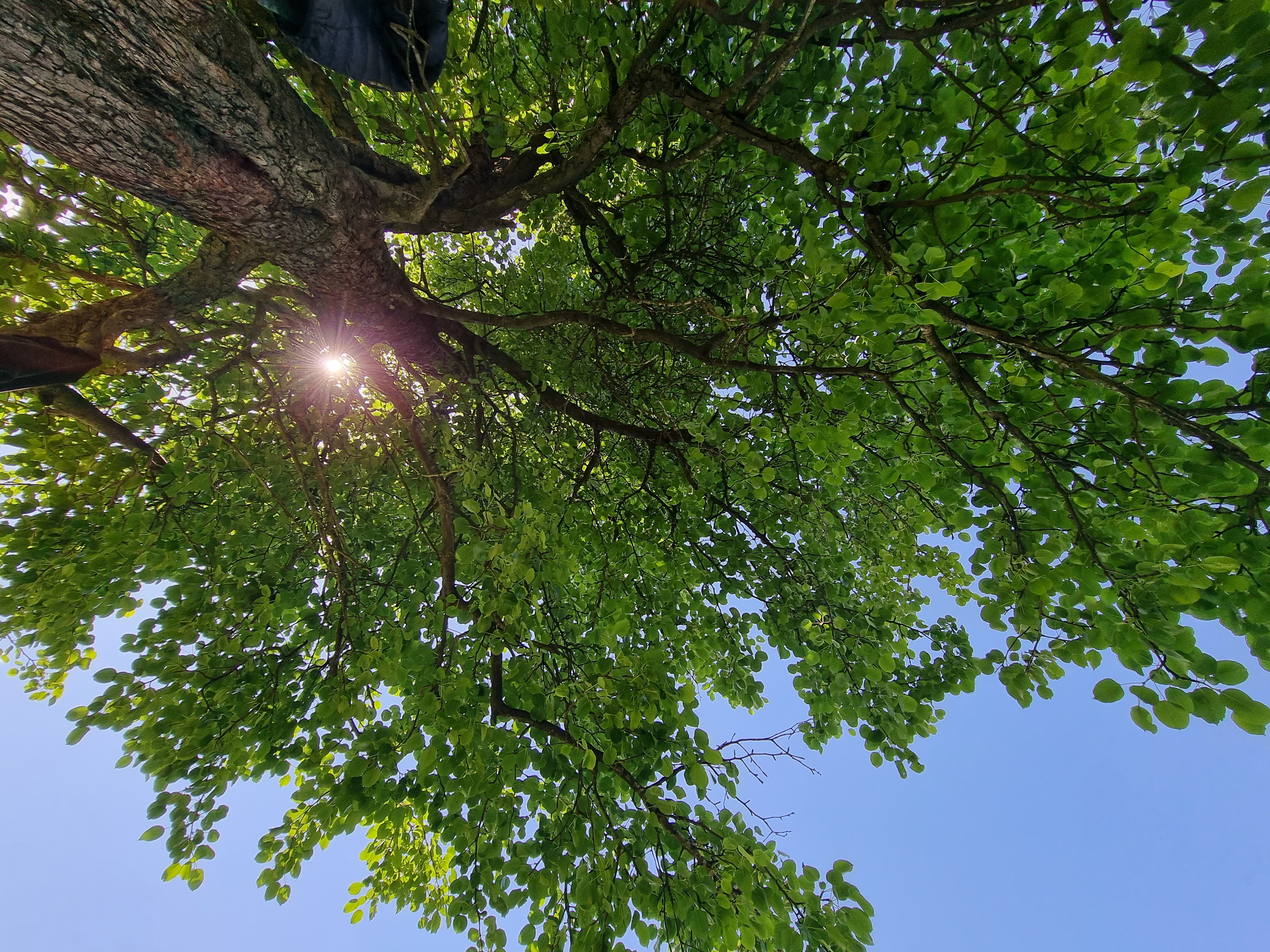
If you stand on the top terrace at Chaptari and look around the horizon, almost every tree you can see is one of two species. Below about 2,200 metres of altitude, the slopes are covered in chir pine (Pinus roxburghii). Above 2,200 metres, they are covered in deodar (Cedrus deodara). Together these two trees define the look of the middle Himalaya. They are not the same tree and they are not interchangeable.
How to tell them apart
Both are tall, both are evergreen conifers, both have needles. From a distance they look similar — dense green columns rising out of a hill slope.
Up close they are obviously different. The chir pine has long, soft, fascicled needles in bundles of three, about twenty centimetres long. Its bark is reddish-brown and breaks into thick, plate-like scales. Its cones are large, woody, and open dramatically in the sun.
The deodar has shorter, harder, needles in tight whorls of thirty or forty, about two centimetres long. Its bark is grey-brown and more finely fissured. Its cones are smaller, barrel-shaped, and held upright on the branches like candles. The wood smells faintly of cedar, because it is one.
The simplest field test: if the needles are long and floppy, it is chir. If they are short and stiff and held in dense clusters, it is deodar.
What chir pine does
Chir pine is a fire-tolerant pioneer species. It grows fast, drops massive needle mats, and crowds out everything beneath it once it has established. The slopes above the farm are part of a chir belt that runs continuously from the Yamuna valley to Nepal. Three things to know about it:
Needle mulch. Each tree drops roughly forty to seventy kilograms of needles a year. The mat decomposes very slowly — three to four seasons — and produces a soil that is acidic, hydrophobic and poor in nitrogen. Most plants struggle to grow under a chir canopy.
Fire. The needle mat is highly flammable when dry. The annual forest fires that the news cycle in May reports as "Uttarakhand burning" are almost entirely chir-pine fires. The forest itself is adapted to them — chir bark is fire-resistant, and the heat opens the cones — but everything else in the understorey is not.
Water. Chir is associated with reduced spring flow in hill catchments. The dense needle mat shed rainwater, the surface horizons go hydrophobic, and infiltration drops by 20–40% compared to a mixed broadleaf forest of the same catchment. The classic Kumaoni complaint that "the springs are drying since the pine came" is a real ecological observation, not folklore.
We are at the chir belt's lower edge — the upper boundary of our land sits at exactly 1,985 m and the chir starts five metres above it. We rake the needle mat into windrows along the contour each autumn and let it compost over two seasons. It is not the easiest mulch in the world to work with, but it is what we have.
What deodar does
Deodar is, in almost every way, chir's opposite. It is slower-growing, fire-sensitive, fungally rich, and associated with springs and year-round flow.
Soil under deodar. The leaf litter is short, dense and decomposes fast — usually one season. The soil beneath an old deodar stand is dark, sweet-smelling, deep, and rich in mycorrhizal networks. If you break a piece of the litter open you will see white fungal threads through it.
Water. Deodar forests are positively associated with spring flow. The fine, deep root mat holds soil structure, the litter layer is spongy, and the canopy intercepts and releases rain rather than shedding it. Most of the year-round springs in the Garhwal hills are under or near a deodar stand. The farm's irrigation spring is two hundred metres below a 150-year-old deodar grove.
Cultural and economic value. Deodar is the most valuable timber tree in the Garhwal Himalaya. The wood is rot-resistant for fifty years; almost every old hill temple and traditional Garhwali house is built from it. Cutting is restricted; ours grows.
Slow. A deodar tree adds a centimetre of trunk diameter every three to four years. The 150-year-old grove above us has trunks about 50 cm across. Our walnut, by contrast, will reach the same diameter in fifty.
Why this matters for a farm
The mix of forest above a hill farm tells you, before you even test the soil, what you are working with.
If your upper boundary is chir pine, expect: an acidic soil pH, slow infiltration, fire risk in May, modest spring flow, and a lot of needle mulch to manage. This is our situation. Most of the work of our first two years was to build organic carbon back into a soil profile that the chir had been depleting for a century.
If your upper boundary is deodar, expect: a fertile loamy soil, a reliable spring, and a fundamentally easier farm to start. There are very few of these blocks of land available in the upper Yamuna valley, and the prices reflect it.
The good news for our slope is that the chir belt is receding upslope — climate change is pushing the band higher by about ten metres of altitude per decade — and the broadleaf forest behind us is slowly coming back. The deodar above is healthy and is not going anywhere.
These are the two trees. Both are great. They are not the same.