
food
Wild fruits of the upper Yamuna valley — hisalu, kafal, burans
Three wild fruits ripen on the slopes around Chaptari each year — hisalu in May, kafal in May to June, burans (the rhododendron flower) earlier still. What they are, where they grow, and what to do with them.
· Sameer Jain · 4 min read
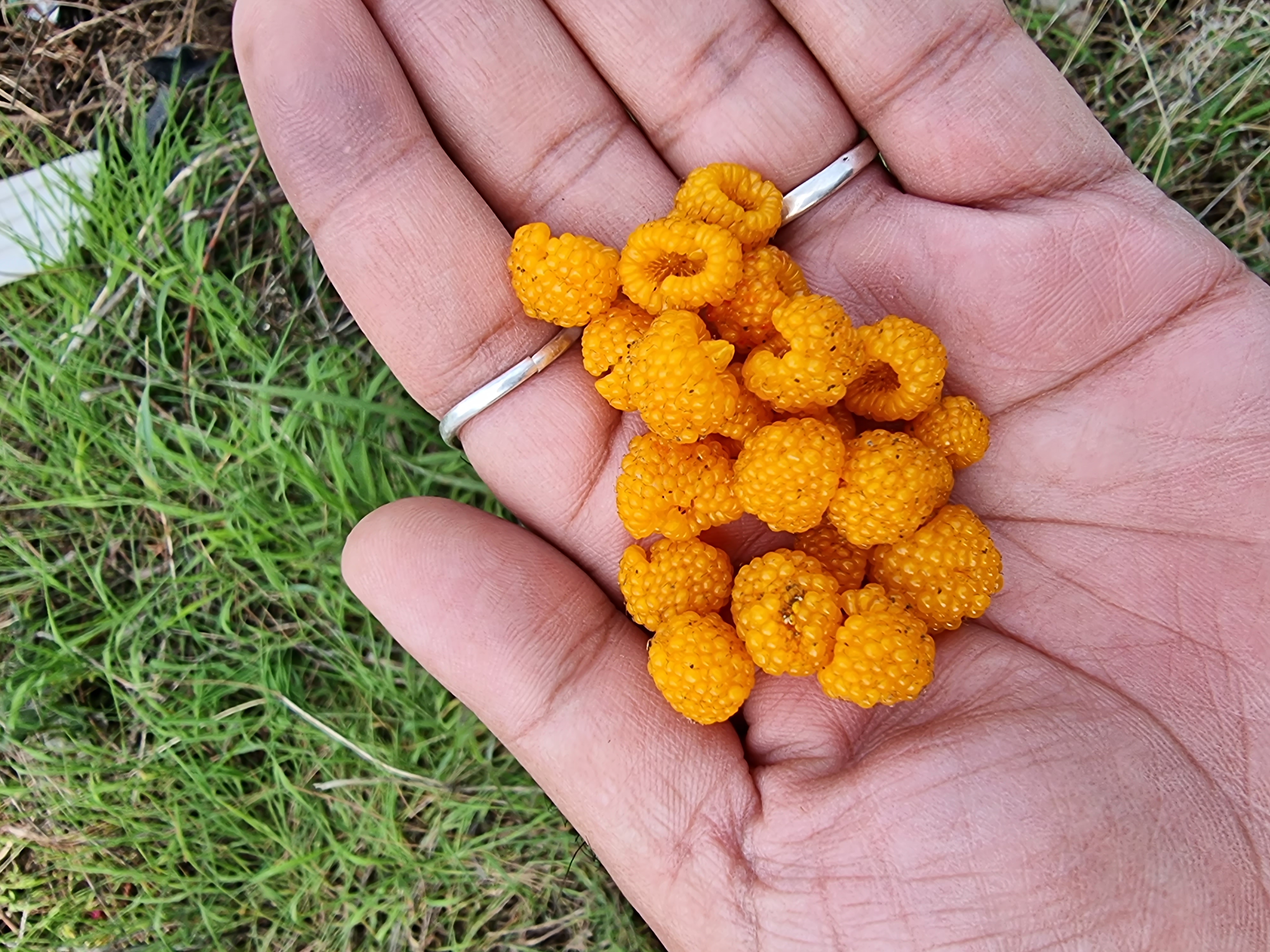
The hill country has a wild larder that the plains do not. Between April and June, three native fruits ripen in succession on the slopes around Chaptari. None of them is cultivated; none of them is in any serious commercial market. All three are local food in the strictest sense.
Hisalu — the golden Himalayan raspberry
Rubus ellipticus. Ripens mid-May to early June at 1,500–2,500 m of altitude. Looks like a thorny bramble with thin reddish stems. The fruit is a hollow, golden-yellow raspberry, smaller than a European raspberry and softer. It is at peak ripeness for about ten days and falls off the bush at a touch.
The taste is honey-sweet and slightly floral — there is more sugar in a ripe hisalu than in most cultivated berries. The bushes are common along open hill paths and the edges of village footways throughout the upper Yamuna valley. Children eat them straight off the bush; adults make small batches of jam and chutney.
We have written about hisalu separately in the hisalu note.
Kafal — the bayberry
Myrica esculenta. Ripens late May through late June, slightly after hisalu and at a similar altitude. Grows on a small, low, gnarled evergreen tree, often on the south-facing edges of village paths and cremation grounds. The fruit is dark red to almost-black, a single small drupe with a fleshy outer layer over a hard stone, the size of a peppercorn.
The taste is sour-sweet, slightly astringent, complex — quite unlike anything in the European fruit basket. Tradition in the upper Yamuna valley is to eat them sprinkled with rock salt and roasted cumin; the salt brings out the sweetness. The fresh fruit does not travel — it ferments within twelve hours of picking — so kafal is almost unknown in the plains.
Kafal also has a Garhwali folk song attached to it (kafal pako chaita mein, meri maita nahin aayi) that almost every hill child in Uttarakhand and Himachal Pradesh learns. It is part of the cultural furniture.
Burans — the rhododendron flower
Rhododendron arboreum. This is not a fruit but a flower, and not a food in the way the other two are. The burans is the deep red, trumpet-shaped flower of the Himalayan tree rhododendron, which covers the upper hill slopes from 1,500 to 3,000 m. The flowering is mid-February through April, earlier the lower you go.
The flower is used three ways. One, the squeezed juice of fresh petals is made into a sweet-sour syrup that is drunk through the summer; it is high in vitamin C and has a long folk reputation as a heart tonic (there is some Indian Council of Medical Research evidence to support this, but cautiously). Two, the petals are dried and brewed as a herbal tea; the colour is dark pink and the flavour is mild and floral. Three, the flowers are made into a jam, similar to rose petal jam in texture but more astringent in flavour.
The state flower of Uttarakhand is the burans. It is the most recognisable visual marker of the central Himalayan spring.
Where to find them, near us
If you walk up the village path from Chaptari into the forest at the upper boundary of the farm, you will pass hisalu bushes in the last week of May along the open edges where the chir pine thins. If you walk further up and to the east, into the deodar belt above 2,200 m, you will find kafal trees scattered through the broadleaf patches that mix with the deodar. The burans is everywhere in March and April — most of the deep-red flowers you see on the hill from fifty kilometres away are burans.
If you walk down the village path, into the lower fields, you will pass none of these. They do not grow well below 1,500 m and they do not grow at all on the cultivated terrace ground. They are forest-edge plants.
What we do with them
We pick about three to four kilograms of hisalu each May, mainly for small jars of jam (we make one jar per harvest and share them with the village team and visitors). The kafal we eat fresh — there is not enough on our slopes to make anything serious with, and the local market in Purola has fresh kafal from larger neighbouring slopes for ₹40–80 a paav (250 g) through June. Burans syrup we make once a year, in late March, when the bottom of the burans flush is in full bloom.
These are three of the foods that make this part of the Himalaya specifically itself. If you visit between mid-April and mid-June you will eat all three.