organic farming
Why we don't use a single chemical
An organic farm in the upper Yamuna valley explains, in detail, why it never sprays a chemical pesticide, herbicide or synthetic fertiliser — what it does instead, and what it costs.
· Sameer Jain · 4 min read
When we say we are an organic farm, we mean it more strictly than the NPOP standard requires us to.
The Indian National Programme for Organic Production allows a long list of permitted inputs that some certified organic farms use heavily — copper sulphate for fungal disease, sulphur for mites, neem-oil formulations against aphids, even sodium bicarbonate at high concentration. They are organic in the sense that they decompose to benign compounds. They are not "no chemicals". We chose, when we drew up the farm plan in 2023, to not use any of them either.
This is not a moral position. It is a pragmatic one.
What chemicals would have done for us
A chemical orchard would be cheaper to run, would have less crop loss in the first five years, and would let the trees come into commercial production a year or two earlier. We are aware of the trade-off. Farmers in this district who do spray get measurable yield uplift. None of that is in dispute.
What chemicals would have done to us
The hillside above Chaptari has not been intensively farmed in living memory. The soil microbial community — the fungi, the protozoa, the mycorrhizal networks that link tree roots underground — is intact in a way most farmland in India is not. The single fastest way to destroy it is a broad-spectrum fungicide. The second-fastest is a broad-spectrum herbicide.
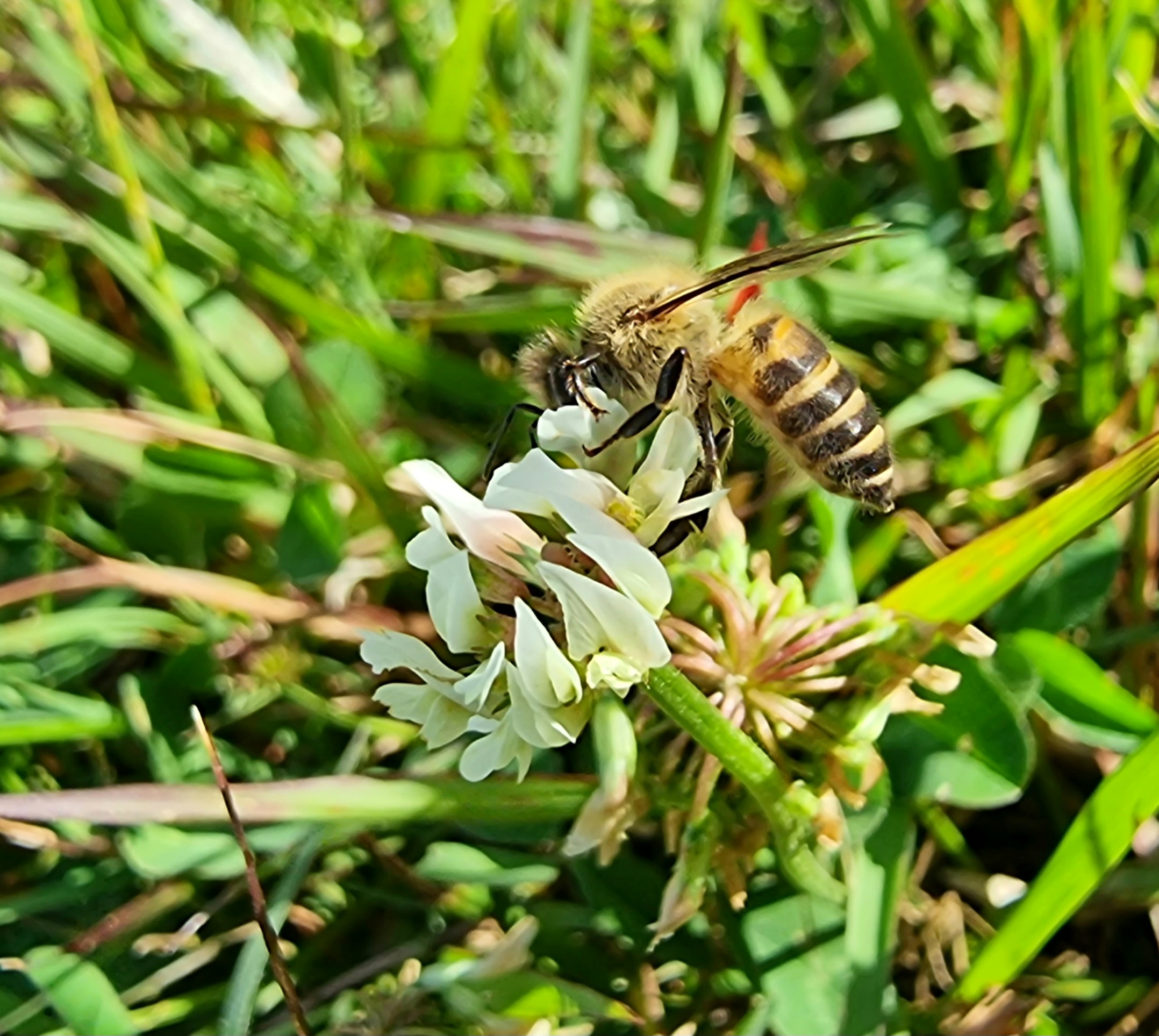
The pollinator population we wrote about in our honeybee on white clover note — seventeen honeybees in ten square metres of meadow — does not survive a single application of a neonicotinoid. Not one panel of bees, not one bush. We watched this happen to a neighbour's apple block two valleys away in 2024 and have not forgotten it.
What we do instead
We do five things, in roughly this order of importance.
One: we feed the soil, not the tree. Cow-dung compost from the village's three milking cows, vermicompost from a small pit Pawan manages himself, and jeevamrit — a traditional Garhwali mixture of cow dung, cow urine, jaggery, gram flour and water, allowed to ferment for 48 hours. Applied as a soil drench three times a year. The trees draw their own nitrogen, phosphorus and potassium from the soil biology, in the form the trees can actually use.
Two: we use the meadow. We do not mow the wildflower strips. They host the bees, the lacewings, the predatory wasps and the small native spiders that handle aphids and caterpillars for us. We have never needed an insecticide because we have never had a pest outbreak that the meadow could not absorb.
Three: we prune correctly. Most fungal problems in stone fruit are the result of poor airflow inside the canopy. We open-vase prune every plum, peach, cherry, almond and persimmon every winter. Air moves; the spores have nowhere to settle.
Four: we keep the village informed. When the neighbour two terraces across decides to spray, we want a week's notice. Drift kills bees too. This is harder to negotiate than the rest combined.
Five: we accept some loss. Last year we lost one walnut to canker and three apple saplings to root rot. In a chemical orchard we might have saved them. In an organic orchard we read the loss as a signal — canker in a damp corner, the rot where the drainage was wrong — and we fix the underlying condition rather than treating the tree. The tree we replace next year does not have the same problem.
The cost
We will produce roughly seventy per cent of what a chemical orchard at this altitude would produce. The trees will take an extra year to come into full production. The labour of the meadow-aware approach is real — Pawan walks the orchard every morning at dawn, every morning.
In exchange we have living soil, a pollinator population most commercial orchards in this state would envy, and, by the time the first commercial harvest comes in 2028, a walnut crop with a depth of flavour that the chemical block cannot match because the soil it grew from is not the same soil.
Not a single chemical. Not a moral claim. Just the longer arithmetic.